
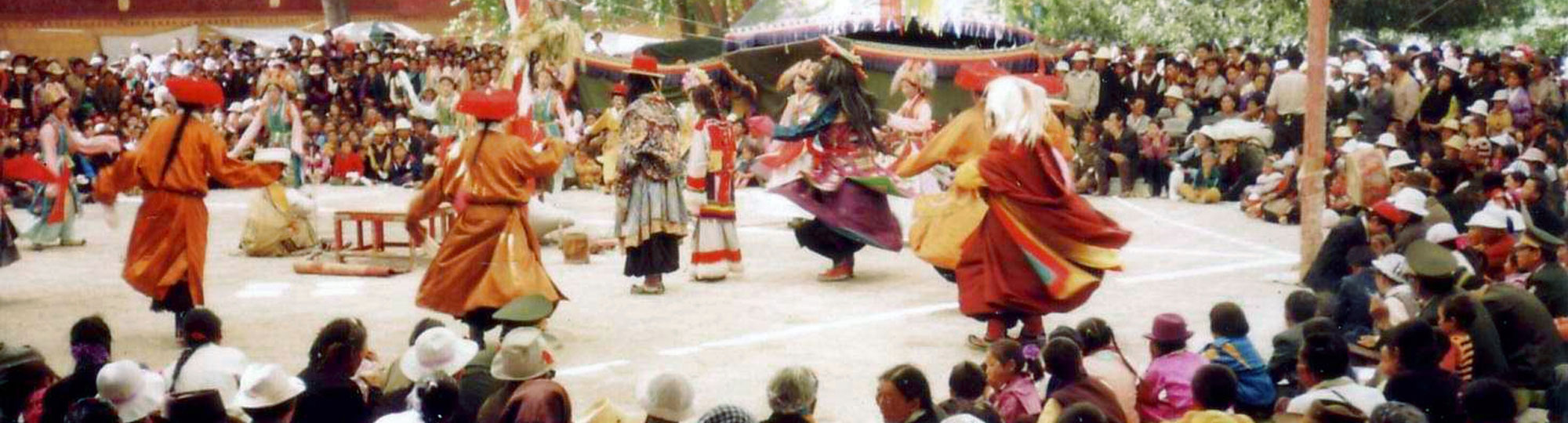
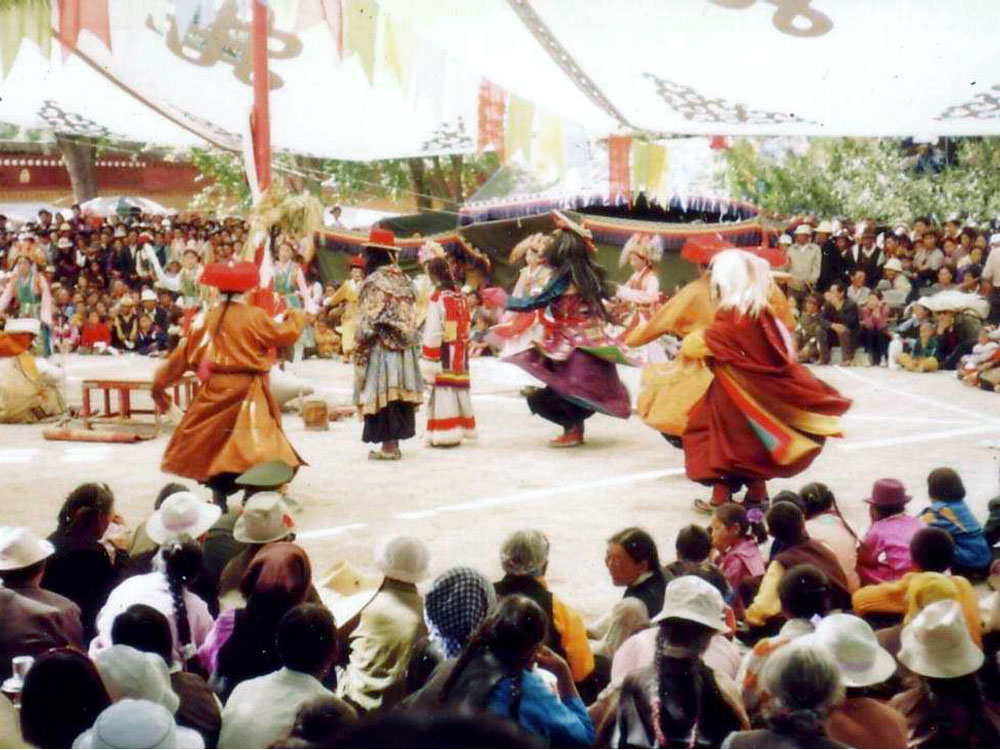
If possible, try to time your visit to Lhasa with one of the city's festivals. Pilgrims often flock to Lhasa at these times and the city takes on a colorful party atmosphere. The following Tibetan festivals are calculated according to the lunar calendar. Check before for the precise dates.
It is the greatest festival in Tibet. In ancient times when the peach tree was in blossom, it was considered as the starting of a new year. Since the systematization of the Tibetan calendar in 1027 A.D., The first day of the first month became fixed as the new year. On the new year's the families unite " auspicious dinner" is offered and the auspicious words " tashi delek" are greeted. It is the most colorful festival of Lhasa. Monlam (great prayer festival of Lhasa)
Known also as the great prayer festival, this is held midway through the first lunar month. An image of maitreya from the jokhang is borne around the barkhor, attracting enthusiastic crowds of locals and pilgrims.
This is the greatest religious festivals in Tibet. Instituted by Tsongkpa in 1409, the founder of the Gelukpa sect. Monks from the Three Great Monastery of Tibet assemble in Jokhang for prayer to Shakyamun¡¯s image as if it were the living Buddha. Pilgrims come from every corner of Tibet and donations are offered to the monks.
'Monlam' means 'Prayer' and at monasteries a great Buddhist service is held and 'Cham' (Buddhist dances) are performed. According to the legend, in the first month of the year, Buddha conquered or converted six holy men of false religions. From New Year's Day until the end of 'Monlam', people continue to eat, drink and make merry.
The Monlam Festival, lasting from the first to the 15th day of the first month of the lunar year, is the largest religious gathering in Tibet. Tsongkhapa, founder of the Yellow Sect introduced the festival, in 1409, during the festival, lamas from the three largest monasteries gather in the Jokhang, reciting scriptures and attending an examination for the Gexi degree.
The date of the Great Prayer Festival (Smom-lam) varies. For the three great Monasteries of Lhasa, it is from the 4th to the 25th day in the first month. For Taer (Ku-bum in Tibetan, i.e., ten thousands images of Buddha) Monastery, it is form the 8th to the 15th day of the first month. For Labrang Monastery, it is from the the 3rd to the 17th day of the first month.
It's held on the 15th of the first lunar month. Huge yak-butter sculptures are placed around Lhasa's Barkhor circuit.
Tibetans at Neqoin Village, Doilungdeqen County in rural Lhasa donned festive clothes on March 3, the fourth day after the Tibetan New Year, to celebrate the "Spring Ploughing Day."
The Tibetans also offered each other and their tractors "hada", auspicious white silk scarves, to wish a bumper harvest.
Neqoin Village, a well-known provider with well-bred seeds for entire Tibet, has achieved constant harvest for the past 18 years. Per capita annual income of its villagers has topped over 2,000 yuan (US$ 250).
The Gyantse Damma Festival has a history of more than 500 years.
It is said that Gyantse King, Pabasangbu had a lot of prestige in the Geshar Dynasty. After his death, his disciples held the worship to memorize him. But it was interrupted because of the war. In 1408, the Gongsang Raopa King, the son of Paba Sangbu, resumed the worship.
From April 10 to 27 of Tibetan calendar, Gongsang Raopa held the worship and recreational activities to memorize his father. Activities include the display of Buddha Portrait, sorcerer's dance in a trance, wrestling and bearing contest. When the Zhaxi Raodan enthroned the Gyantse-King in 1447, the horsemanship, archery, Tibetan opera, dancing and singing were supplemented, forming the Gyantse Dama Festival still being observed today.
It is the holiest in Tibet, there memorable occasions coincide on this day, buddha's birth and buddha's enlightenment. Almost every person within Lhasa join in circumambulations round the city and spend their late afternoon on picnic at "dzongyab lukahng" park at the foot of potala.
Horse race and archery are generally popular in Tibet, and gyantse enjoys prestige of being the earliest in history by starting in 1408. Contests in early times included horse race, archery, and shooting on gallop followed by a few days' entertainment or picnicking. Presently ball games, track and field events, folk songs and dances, barter trade are in addition to the above.
As the most important festival in north Tibet during the golden season on the grassland, thousand of herdsmen throng to nakchu riding fine horses, and carrying the local products. They form as city of tens south of nakchu town. There will be thrilling horse race, archery and demonstrations of horsemanship. Songs and dance troupes from all part of Tibet will add to the fun.
There are many horse racing festivals in Tibet, the one in Nagqu of Northern Tibet is the greatest. August is the golden season on Northern Tibet's vast grassland. Herdsmen, on their horsebacks, in colorful dresses, carrying tents and local products, pour into Nagqu. Soon they form a city of tents. Various exciting programs are held, such as horse racing, yak racing, archery, horsemanship and commodity fair.
It is one of the major festivals in Tibet, also known as the Tibetan Opera Festival. The founder of the Gelugpa (Yellow Sect of Buddhism), Tsongkhapa set the rule that Buddhists can cultivate themselves only indoor in summer, to avoid killing other creatures carelessly. This rule must be carried out till the seventh lunar month. Then Buddhists go outdoors, accept yoghurt served by local people, and have fun. Since the middle of 17th century, the Fifth Dalai Lama added opera performance to this festival. Famous Tibetan opera troupes perform in Norbulingka
On the 15th day of the 6th Tibetan month, 25 precious articles belonging to ganden monastery, which are normally locked in their treasure house, are displayed in the main shrine hall. A grand offering ceremony accompanies the display. These articles consist of the images of the sixteen arhats, akshobhya, the secret assembly, the four great kings, the upasaka and hashang image.
The farmers in Lhasa, gyantse and shangnan to celebrating their bumeer harvest in this time. During that time, people enjoy with horse racing games, costume fashion show, songs and dance archery and picnic etc.
It is believed when the sacred planet Venus appears in the sky, the water in the river becomes purest and cure diseases. During its appearance for one week in the sky, all the people in Tibet go into the river for bathing.
Long time ago, when Tibet was in danger of large scale invasion, the Kongpo people sent out an army to defend their homeland. It was in September and the soldiers worried that they might miss the New Year, highland barley wine and other good things. So people had the Tibetan New Year on 1st October ahead of time. To memorize those brave soldiers Kongpo people present three sacrifices and stay up at night from then on. And now it has become the Kongpo Festival for entertainment like Kongpo dancing, horse race, archery and shooting.
December 15 marks the annual Tibetan Fairy Maiden Festival (Auspicious Goddess Festival). Tibetans gather in Lhasa around the Jokhang Monastery for presenting hadas to Auspicious Goddess.
Every October 15 on the Tibetan calendar, the Tibetans, especially Tibetan women, would gather in Lhasa around the Jokhang Temple to pray for happy marriage and true love.
Local legends have it that once upon a time the third and youngest daughter mistreated her mom who before dying laid a curse: when married, her lazy daughter would meet her husband once a year on October 15.